Showing posts with label BRIGHTON. Show all posts

Sunday, 30 October 2016

GEORGE ALBERT SMITH ~ PIONEER OF EARLY FILM


George Albert Smith 
January 4 1864 ~ May 17 1959


Before making his name in the world of film, GA Smith had already been involved in the visual entertainment trade. He performed as a stage hypnotist, a psychic, and a magic lantern lecturer. But his films are what he is remembered for best, particularly the technical expertise that led to him developing successful colourised moving films: a method called Kinemacolour.

Following the death of his father, George went to live in Brighton where his mother ran a boarding house. It was there ~ often in the Aquarium ~ that his stage illusionist act began. And perhaps his skill at deceiving the eye was what led Edmund Gurney, Honorary Secretary of the Society for Psychical Research, to be entirely convinced that Smith was a genuine spiritualist and to employ him as his secretary. 

But, when accused of being a fraud Smith left the SPR in 1892 and leased St Anne's Well Gardens in Hove. There, he then went on to develop the park as a popular seaside pleasure resort, gleefully described by the local press as: 'This delightful retreat ... presided over by the genial Mr G. Albert Smith, is now open ... In the hot weather the refreshing foliage of the wooded retreat is simply perfect, while one can enjoy a cup of Pekoe in the shade'.

The gardens were indeed elaborate, with hot air balloons, and parachute displays, a monkey house, a fortune teller, and a hermit living in a cave - not to mention the magic lantern shows which used clever scenery and lights to create dissolving picture shows which were advertised at the time as :"High Class Lecture Entertainments with Magnificent Lime-Light Scenery and Beautiful Dioramic Effects."

Many skills learned for this craft went on to be used when editing moving films - the interest that obsessed Smith after seeing the films of Robert Paul, after which he also joined forces with others in the local Brighton film industry - as well as securing a friendship with the French director, Georges Melies. 

By 1889, having acquired his first moving film camera from the Brighton-based engineer Alfred Darling, and with chemicals bought from James Williamson, a Hove chemist and fellow film pioneer, Smith erected a purpose-built glass house in the grounds of St Anne's Gardens, specifically for making films. Films such as The Kiss in the Tunnel, The Sick Kitten, The House that Jack Built, Grandma's Reading Glass, and As Seen Through a Telescope.
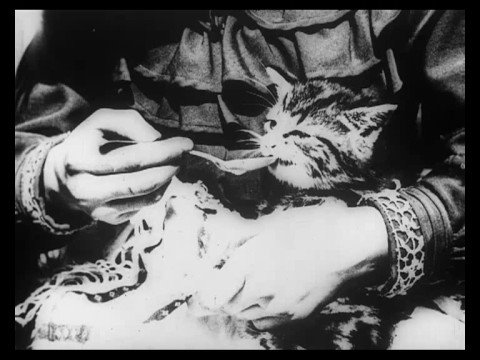

The Sick Kitten ~ click on image to see this film


Many of his short comedy films (usually no more than a minute in length) starred the local comedian Tom Green, as well as Mr Smith himself, and his wife, Laura Bayley ~ with Laura being an actress who'd worked before in stage pantomimes and also in comic revue shows.


G A Smith and Laura Bayley starring together in A Kiss in the Tunnel
Click image to see the film


However, by 1904 Smith left St Ann's Well Gardens and moved to Southwick in Sussex - the house he called Laboratory Lodge, which is where he was to concentrate on developing his colour film. Films that illustrated this are Woman Draped in Patterned Handkerchiefs, and A Visit to the Seaside - both created in 1908 and resulting in Smith being awarded a Silver Medal by the Royal Society of Arts. More colour films were made until Smith and his long time partner/financier, Charles Urban were put out of business following a patent suit filed by William Friese-Green. This effectively ended Smith's career - after which he was sometimes said to be seen out on the Brighton seafront peering through his telescope - by then becoming a fellow of the Royal Astronomical Society.


A Visit to the Seaside - click on image to view the film


However, he was not entirely forgotten in the world of film. In the late 1940's, and well before his death, G A Smith was given the honour of being made a fellow of the British Film Academy. And today you can learn more about his work by visiting the Hove Museum where there is a permanent display dedicated to his genius.


Wednesday, 27 July 2016

EDWARDIANS AT THE SEASIDE ...BEHAVING BADLY?


When a novel is set in a seaside town it gives such a colourful setting. Add a little history to that mix and you have the gift of nostalgia too. Old postcards. Punch and Judy tents. Donkey rides upon the beach, and - in my case - the Brighton Pier, the aquarium, the Pavilion, the pubs and the shops in the narrow Lanes; all bustling and full of life.


Many Edwardian employees had around two weeks annual holiday. There were cheap train excursions to seaside towns. From London to Brighton in 53 minutes, and there to enter a different world with pier shows, with clowns and minstrels, and many other amusements too.


The seaside towns were liberating. A chance to dress up in your finest clothes, to become something fresh and new again; well away from the grime and daily grind of working lives in many towns. Those retired and better-off might also go during the winter months to take the health-enhancing air. But, the mainstay for the tourist trade was in the summer visitors - when whole families might book themselves into boarding houses or hotels, with varying degrees of luxury. Young men would travel down alone, or else along with packs of friends, heading out after breakfast every day to look for some excitement. And, due to raunchy behaviour upsetting the local residents some seaside resorts banned Sunday trains in the hope of preserving a small degree of gentility on the sabbath days.

The following is an extract, taken from Punch magazine ...

Saturday and Monday, and every working day in the summer week, Bournemouth is blithe and gay. Steamers are running hither and thither, wagonettes, coaches, gardens with music, excellent bands on (the) well-appointed pier, concerts, donkey-riding, al fesco refreshments ... in fact, everything that is considered by the majority as constituting 'appy 'oliday is to be found at its best ... But every Saturday night, long before the stroke of twelve, bands, lights, cocoa-nuts... and people that make life quite impossible, vanish, as if by magic, not to be heard of or seen again till Monday morning...


For a related post, you might like to see:  FILM OF MORECAMBE SEAFRONT, 1901


Wednesday, 6 July 2016

MAGNUS VOLK'S ELECTRIC RAILWAY IN BRIGHTON


While researching Edwardian history for my novel, The Last Days of Leda Grey, I came across some photographs of an old electric railway. For quite a long time I was going to use those details in the novel's plot, though eventually it turned out to be one of the elements I cut. Still, I think it's a story that should be shared, not least because Volk's Railway still runs on the Brighton seafront today ~ and hopefully will for many years.


Magnus Volk was born on October 19, in the year of 1851. The son of a German clock-maker he was born and raised in Brighton, growing up to make his name as an electrical engineer. He was, as a small aside here, the very first person in Brighton to install electric lights at home. But today, he is most widely known for Volk’s Electric Railway, first opened in 1883 and running along the Brighton front ~ from Black Rock to what was then Chain Pier.


Powered by an electric dynamo (problems could occur when the sea sprayed up and the railway lines became too wet) this narrow gauge seafront railway soon became a popular tourist attraction.


Sadly, the original passenger car ~ which carried up to twelve passengers, had mahogany sides and blue velvet curtains ~ was eventually scrapped, with the damp and the salt in the atmosphere only adding to the general wear and tear. 

The boarding stations changed as well, with the latest constructed in 1998. And at times the railway line has closed - either due to adverse weather conditions, to the building of groynes upon the beach, the construction of the Black Rock Lido, or during the time of World War II when much of the sea front was damaged.


But Volk's old railway carries on. And, more recently, in 2014, the line received a heritage grant which hopefully will now provide the costs of creating a new ticket centre set in the town Aquarium. It will also help with all the work to restore the damaged cars, and the creation of educational material regarding the railway’s history.

In the meantime, for more detailed information and current news about the line, please do take a look at the excellent website: VERA (Volk’s Electric Railway Association).